 View full PDF
2025 · Sustainable Cities and Society
An indicator-based framework of circular cities focused on sustainability dimensions and sustainable development goal 11 obtained using machine learning and text analytics
Nadia Falah, Navid Falah, Jaime Solis-Guzman, and Madelyn Marrero
Abstract: Develops a city-level framework of 241 circular-city indicators. Machine learning, text analysis, and clustering classify the indicators across environmental, economic, and social dimensions and map them to 16 SDG 11 classes.
Validation finding: 75% of indicators are multi-dimensional, while lower-coverage SDG 11 classes identify where indicator sets need strengthening.
 View full PDF
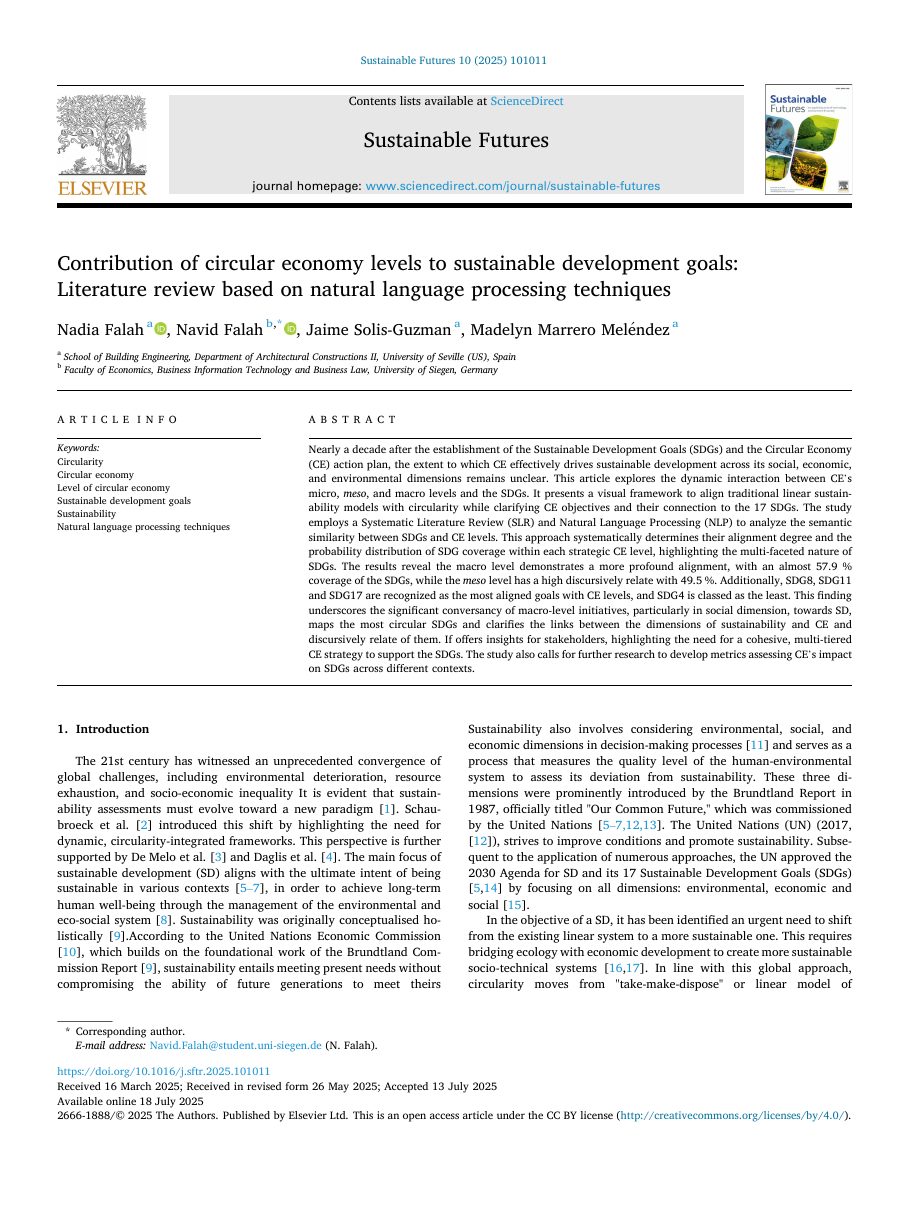
2025 · Sustainable Futures
Contribution of circular economy levels to sustainable development goals: Literature review based on natural language processing techniques
Nadia Falah, Navid Falah, Jaime Solis-Guzman, and Madelyn Marrero Meléndez
Abstract: Combines a systematic literature review with NLP to evaluate how micro, meso, and macro circular-economy levels align with all 17 SDGs and the three dimensions of sustainability.
Validation finding: Macro-level initiatives show 57.9% SDG coverage; SDG 8, SDG 11, and SDG 17 have the strongest alignment with circular-economy levels.
 View full PDF
2026 · Environmental Development
Mapping circular city indicators onto the 10R framework: A multi-method AI-powered approach for gap analysis and semantic clustering
Nadia Falah, Navid Falah, and Neda Falah
Abstract: Uses transformer sentence embeddings, ensemble weighting, semantic similarity, and clustering to classify 241 city indicators across the 10R hierarchy and expose measurement blind spots.
Validation finding: 58% of indicators map to downstream Recycle/Recover strategies, versus under 8% for mid-life extension strategies - evidence for a more balanced measurement framework.
 View full PDF
2026 · Cities
Measuring the level of circular economy in cities in alignment with sustainable development goal 11: Integration of machine learning algorithms and analytical hierarchical-network processes. A case study in Seville
Nadia Falah, Navid Falah, Madelyn Marrero, and Jaime Solis-Guzman
Abstract: Presents a four-level city-circularity assessment model that integrates 123 metrics from 59 circular-city indicators with transformer models, ensemble learning, and AHP/ANP-inspired decision analysis.
Validation finding: Applied to Seville’s 2023 data, the model calculated 7.25 out of 19.57 (37.05%), demonstrating a repeatable basis for comparison and time-series analysis.